
One moment you are going about your normal day-to-day routine and suddenly the unexpected happens; you twist, fall, get knocked from your bike or are involved in a car crash (to name just a few examples). Trauma spans from ‘minor injuries’ all the way to ‘major injuries’, however, the size of the injury does not always correlate with the impact on your life.
Trauma is messy and doesn’t always follow the rules; everyone heals differently.
What we do know is how the body repairs itself. Understanding that process can make it easier to understand why recovery takes time.
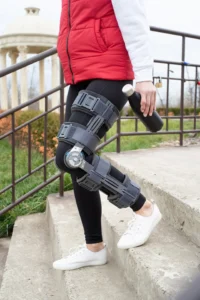
Bone healing:
Before we continue any further, it’s worth clarifying that a fracture and broken bone are one and the same!
Although every fracture is different, bone healing usually follows four overlapping stages. The timing varies depending on the type and severity of the fracture, where it is in the body, and how it is treated.
Days 0 to 5 – The body starts the repair process (haematoma)
When a bone breaks, it also damages nearby blood vessels, causing bleeding around the fracture. This blood forms a clot, creating the body’s first framework across the break, and providing the foundation for healing. The body’s natural clean-up system sends special cells to the area, removing damaged tissue and preparing the area for repair.
What this means for you – Pain, swelling, and warmth around the injury are completely normal at this stage.
Day 5-11 – Building a temporary support (soft callus formation)
Your body starts producing new tissue around the fracture, creating a soft cartilage support that gently holds the broken bone together. You can think of this as a temporary scaffolding while stronger bone is gradually built.
What this means for you – Pain and swelling often begin to settle, but the bone is still vulnerable and needs protection.
Day 11-28 – Replacing the temporary support with new bone (hard callus formation)
The soft cartilage is gradually replaced with new bone, making the fracture stronger and more stable. This is the stage where X-rays often begin to show signs that healing is taking place.
What this means for you – The fracture feels more stable, although it is still not fully healed.
From around three weeks onwards – Strengthening and reshaping (remodelling)
Over the following months, and sometimes years, your body continues to strengthen and reshape the new bone. It gradually becomes more like the bone you had before your injury, adapting to the loads placed on it.
What this means for you – Although you may feel much better, your bone continues to strengthen behind the scenes. Recovery can go up and down as you increase activity.

Bony Healing ‘Take Home Message’
Your surgeon and physiotherapist will often, but not always, encourage you to weight-bear through your injury; this normally goes against everything your brain is telling you! ‘You’ve broken a bone’ it says, ‘don’t put your weight on it, it will break!’. In fact, if you have been told to weight-bear, it is because appropriate loading helps stimulate bone healing. The right amount of movement and weight encourages your body to build stronger bone in the places it is needed most.
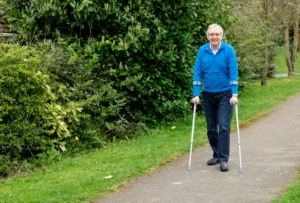
Deconditioning – why do muscles weaken (atrophy)?
Everyone has heard the phrase ‘if you don’t use it, you lose it’. This is especially true when it comes to immobilisation. Evidence shows that disuse muscular atrophy occurs more rapidly in the acute phase, most so in the first 14 days of immobilisation. The rate then starts to slow and eventually plateaus. We also know that if you spend time in critical care, the rate of atrophy is significantly higher. Different muscles also atrophy at different rates. Even if you are allowed to weight-bear (as above), it is extremely unlikely that you will continue to use the injured limb or limbs in a normal way; pain, swelling, apprehension, and walking aids all limit this; therefore, muscle loss is inevitable.
Deconditioning is not just about muscle loss, though. When you’re unable to carry out your usual activities, whether it be day-to-day tasks or sport-specific training, you will also have a reduction in cardiovascular fitness, energy and wellbeing. All these take time and graded activity to rebuild.
Soft Tissue Healing
Soft tissues, including muscles, tendons, ligaments and skin, heal in a similar process to bone. Although the timings vary depending on the injury, healing generally progresses through four overlapping stages.
Day 0-1 – Stopping the bleeding (haemostasis)
Immediately following an injury, your body works to stop any bleeding and create a clot. This clot provides a temporary framework that protects the injured area while healing begins.
What this means for you – Pain, swelling, tenderness, and bruising are common.
Day 1–5 – Cleaning up the injury (inflammatory phase)
Your body’s immune system migrates into the injured area to remove damaged tissue and begin the repair process. This natural response is called inflammation and is an essential part of healing.
What this means for you – Pain, swelling, warmth and redness are often most noticeable during this stage.
Days 5–21 – Rebuilding the tissue (proliferative phase)
Your body starts producing new tissue to repair the injury whilst also developing tiny new blood vessels to support healing. The injured area gradually becomes stronger, although new tissue is still developing.
What this means for you – pain and swelling usually begin to improve, movement becomes easier and the injured area starts to tolerate more activity.
From around 3 weeks onwards – Strengthening and remodelling the tissue (remodelling phase)
Over the following weeks and months, the repaired tissue becomes stronger and reorganised. It gradually adapts to the demands placed on it, maturing and becoming more resilient.
What this means for you – Strength, movement and confidence continue to improve, although some injuries may never return to the same properties as before.
The Emotional Side of Trauma
Recovering from trauma isn’t purely biological. Years of working with trauma patients have shown that psychosocial factors often have just as much impact as the injury itself. A sudden loss of independence, concerns about pain and causing damage, and an inability to take part in your normal activities have a huge impact on recovery. The important thing to remember is that this is OK. Some clients struggle with a real loss of identity; they are unable to fulfil their ‘normal roles’, whether that be as a parent, carer, main earner or anything else important to the individual. Recovery isn’t just about healing tissues; it’s also about rebuilding confidence, independence and trust in your body, even when movement can feel uncomfortable or even threatening. Your treating team will support and guide you in your recovery and gradually reintroduce meaningful activities, even if in an adapted way.
The other thing to remember: trauma is traumatic! It’s right there in the name! These injuries come out of the blue and can be extremely scary. Flashbacks, fear avoidance behaviour, difficulty sleeping, and post-traumatic stress disorder can be common. It is essential that you mention any of these difficulties to your team, support is available for you, so please reach out.
Managing your expectations
So, let’s summarise: trauma is so much more than a broken bone. You have pain, swelling, movement restrictions; your muscles and cardiovascular system decondition; your brain is trying its best to protect you. Even relatively straightforward injuries continue to heal and remodel for many months. While many people return to normal activities much sooner, recovery often continues long after the pain has settled. Try to use this information to remind yourself why you can’t do x, y or z straight away and, most importantly, be kind to yourself while you heal. As physiotherapists, we notice (and get very excited about) what may seem tiny and trivial to you; setting individualised goals with you can help you too to see the progress you are making.
It is also normal for your body to react when we try to progress to something new. Again, let’s normalise this; we approach change in a graded way, but you will inevitably have a combination of swelling, pain, fatigue or impact on function temporarily as the body adjusts to new activity. This doesn’t necessarily mean you’ve caused damage; we are gradually increasing what you can tolerate, not avoiding all discomfort. Healing is rarely a straight line. There will be good days and more difficult ones, but that doesn’t mean you’re going backwards. Look back over weeks rather than days and celebrate the small (and big!) improvements along the way.
The body has an amazing ability to repair itself, it just needs time, the right amount of movement, and patience.
References:
Deane, C.S., Piasecki, M. and Atherton, P.J. (2024) Skeletal muscle immobilisation-induced atrophy: mechanistic insights from human studies. Clinical Science, 138(12), pp. 741–756. Available at: https://doi.org/10.1042/CS20240010 (Accessed: 29 May 2026).
Hardy, E.J.O., Inns, T.B., Hatt, J., Doleman, B., Bass, J.J., Atherton, P.J., Lund, J.N. and
Phillips, B.E. (2022) The time course of disuse muscle atrophy of the lower limb in health and disease. Journal of Cachexia, Sarcopenia and Muscle, 13(6), pp. 2616–2629. Available at: https://doi.org/10.1002/jcsm.13067 (Accessed: 29 May 2026).
Olive, P., Hives, L., Wilson, N., Ashton, A., O’Brien, M.C., Mercer, G., Jassat, R. and Harris, C. (2022) Psychological and psychosocial aspects of major trauma care in the United Kingdom: a scoping review of primary research. Trauma, 25(4), pp. 338–347. Available at: https://doi.org/10.1177/14604086221104934 (Accessed: 3 June 2026).
ScienceInsights (2026) When does a broken bone start to heal: 4 stages. Available at: https://scienceinsights.org/when-does-a-broken-bone-start-to-heal-4-stages/ (Accessed: 15 May 2026).
Smith, J. and Patel, R. (2021) Fracture healing overview. Available at: https://www.researchgate.net/publication/353681662_Fracture_Healing_Overview (Accessed: 15 May 2026).
Wallace, H.A., Basehore, B.M. and Zito, P.M. (2023) Wound healing phases. In: StatPearls [Internet]. Treasure Island (FL): StatPearls Publishing. Available at: https://www.ncbi.nlm.nih.gov/books/NBK470443/ (Accessed: 3 June 2026).